I Tracked My Digestive Symptoms With This Food Diary Journal for 90 Days

9 min read

This post contains affiliate links. As an Amazon Associate, I earn from qualifying purchases at no extra cost to you.

I am a qualified nutritionist, not a gastroenterologist. The experiences shared here are personal and clinical observations. Always consult your doctor before starting any new supplement or health protocol, especially if you take medication or have a diagnosed digestive condition.

Over the past 15 years in clinical nutrition, I have seen one pattern repeat itself endlessly. Clients arrive with bloating, unpredictable bowel habits, and creeping fatigue — yet they cannot tell me when symptoms strike, what they ate beforehand, or how their stress levels compared on their worst days. Using a food diary journal to track digestive symptoms is, in my professional opinion, one of the most underused and most powerful tools in gut health management. So when a new structured journal landed on my radar promising to combine food logging, symptom scoring, and FODMAP tracking in a single portable format, I decided to put it through a proper 90-day personal trial.

I should be transparent: I tested this journal on myself, not just recommended it to clients. I have mild post-infectious IBS that flares around high-stress periods. My symptoms are manageable, but the trigger patterns have always been frustratingly inconsistent. That inconsistency is exactly what I hoped structured tracking would resolve.

Why I Chose the 75-Day Food Diary & Symptom Tracker Journal

There are dozens of symptom notebooks on the market. Most are glorified blank lined journals with a food column bolted on. What drew me to the 75-Day Food Diary & Symptom Tracker Journal for Gut Health was its specific design for conditions like IBS, FODMAP intolerance, and food allergies — not a generic wellness planner repurposed for gut health.

The Monash University Low FODMAP program consistently emphasises that elimination diets only work when accompanied by rigorous symptom journaling. NICE guidelines for IBS management similarly recommend food and symptom diaries as a first-line self-management strategy. A well-structured journal isn’t optional — it’s clinical infrastructure.

Specifically, I was looking for a format that could capture meal composition, symptom timing, stool type (Bristol Stool Scale), bloating severity scores, sleep quality, stress levels, and potential allergen flags — all in one daily entry. The 75-Day Food Diary & Symptom Tracker Journal appeared to offer exactly that. The B5 compact size also meant it could travel with me easily, which matters when you’re eating across different environments throughout the day.

First Impressions: Build Quality and Layout

The journal arrived well-packaged. My first impression was genuinely positive. The 300gsm PVC-protected hardcover feels substantial without being heavy — it doesn’t flop open on a café table, which sounds trivial but matters enormously for daily compliance.

The 100gsm no-bleed paper is a thoughtful inclusion. I use a felt-tip pen for my annotations, and on cheaper journal paper, ink bleeds through and makes the reverse side illegible. Here, there was no bleed-through at all across 90 days of daily use. That detail alone sets it apart from several competitors I’ve tested.

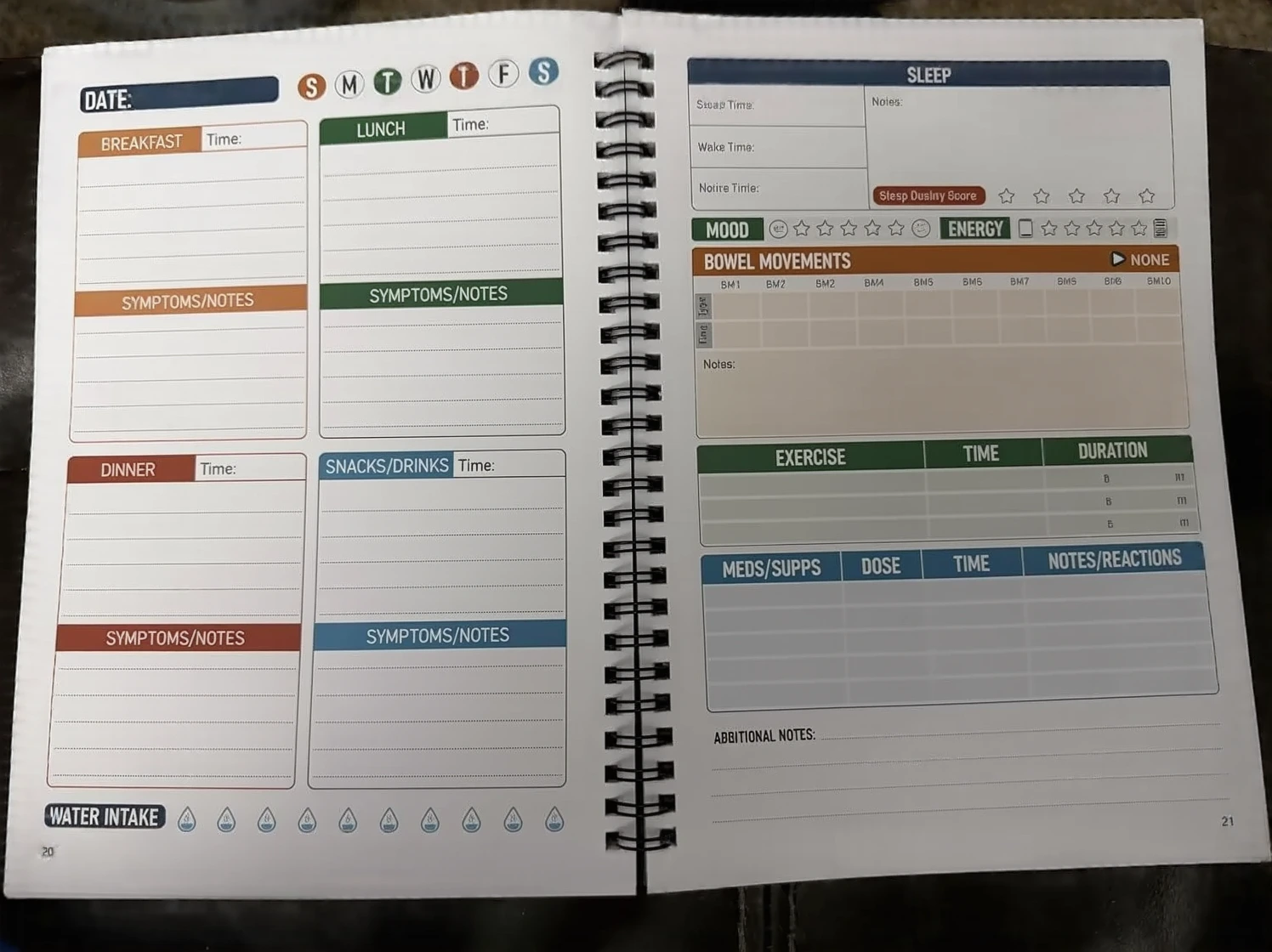
The layout itself is clean and logical. Each daily spread includes dedicated sections for meals, water intake, supplements, symptoms with severity ratings, bowel movement logging (aligned with Bristol Stool Scale types 1–7), energy levels, mood, and a free-notes section. The structure is pre-built but not prescriptive. In my experience, overly rigid formats lead to abandonment within two weeks. This one balances guidance with flexibility well.

Ease of Daily Use

Completing a daily entry took me approximately five to eight minutes. That is a realistic time commitment. Many clients have told me they abandoned previous journals because entries felt overwhelming. This format avoids that trap. The prompts are specific enough to be useful, but brief enough to stay sustainable.

My 90-Day Testing Protocol

I ran a structured 90-day trial, using the journal across three distinct phases that mirror the clinical FODMAP protocol I use with clients.

  • Weeks 1–4 (Baseline): No dietary changes. I logged everything — meals, snacks, stress events, sleep duration, Bristol Scale scores each morning, and bloating on a 1–10 scale recorded at 8am, 1pm, and 7pm daily.
  • Weeks 5–10 (Low FODMAP Elimination): I followed a strict low FODMAP protocol, cross-referencing with the Monash FODMAP app. All meals and symptoms continued to be logged daily.
  • Weeks 11–13 (Reintroduction): I reintroduced FODMAP groups one at a time, three days per group, logging all symptom responses with timestamps.

Throughout all three phases, I also logged my probiotic supplementation timing. Research into Lactobacillus rhamnosus GG — arguably the best-studied strain for IBS-related symptom management — suggests that consistent daily timing improves colonisation outcomes. Logging supplement timing alongside symptoms allowed me to notice correlations I might otherwise have missed.

I tracked six primary outcome measures each day: bloating score, stool consistency (Bristol type), urgency episodes, energy rating, sleep quality, and perceived stress level. This gave me a genuinely multi-dimensional picture of my gut health over time.

What Actually Changed After 90 Days of Tracking My Food Diary Journal Digestive Symptoms

By the end of week four, the baseline data alone was revelatory. I identified that my worst bloating days consistently followed evenings with more than two servings of high-fructan foods — specifically garlic and onion — combined with poor sleep the night before. Neither factor alone appeared to trigger significant symptoms. The combination did. I would never have spotted this pattern without structured timestamped logging.

During the elimination phase, my average midday bloating score dropped from 6.2 to 2.8 out of 10. Bristol Stool Scale entries shifted from a mix of types 6 and 7 (loose and watery) to predominantly type 4 (ideal sausage form) by week eight. These are meaningful, observable changes.

The reintroduction phase was where the journal truly earned its keep. I identified fructans (wheat and onion specifically) as my primary trigger, with lactose producing a mild but consistent response. Sorbitol, on the other hand, produced no measurable symptom increase across three days of logging. That granular information is clinically actionable. It means I can target my dietary management precisely, rather than following a blanket avoidance approach indefinitely.

Client Observations That Mirror My Own Results

In my clinical practice, I have recommended structured symptom journals to clients for years. However, I introduced the 75-Day Food Diary & Symptom Tracker Journal to four clients during this same 90-day period. One client — a woman in her early 40s managing post-cholecystectomy diarrhoea — found the Bristol Scale logging particularly useful. She and I were able to identify a clear correlation between high-fat meals and same-day urgency episodes. Previously, she had attributed her symptoms to stress alone. The data told a different story.

Another client with suspected non-coeliac gluten sensitivity used the journal during a supervised elimination. His energy ratings improved by approximately 30% during the wheat-free phase, which he had not previously connected to his diet. That insight shifted his motivation significantly. In my experience, seeing your own data is far more persuasive than any advice I can give.

The Downsides You Should Know

No product is without limitations. I want to be direct about where this journal fell short for me.

First, the journal covers 75 days. My 90-day protocol required a second journal for the final 15 days, which created a minor continuity issue when reviewing data across phases. For a standard FODMAP protocol — which runs roughly 8 weeks — 75 days is sufficient. However, longer-term chronic condition tracking will require multiple volumes.

Second, there are no pre-printed FODMAP food reference lists inside the journal itself. I supplemented with the Monash FODMAP app. Beginners who don’t know which foods are high FODMAP will need an external resource. The journal tracks beautifully, but it doesn’t teach the FODMAP diet from scratch.

Third, the free-notes section per day is relatively compact. On high-symptom days when I wanted to write detailed narratives about possible confounders — a particularly stressful work meeting, an unusual meal at a restaurant — I occasionally ran out of space. A slightly larger notes field would improve this.

That said, these are genuine but relatively minor criticisms. None of them affected the core tracking functionality that makes this journal genuinely useful.

Who Should Buy This (and Who Should Skip It)

This journal is well-suited for specific groups. In my clinical opinion, the following people would benefit most:

  • Individuals with diagnosed or suspected IBS following a FODMAP elimination protocol under professional supervision
  • People investigating food allergies or intolerances who need structured, timestamped data to share with their GP or dietitian
  • Anyone who has tried vague food diaries and found them ineffective ��� the structured prompts here make a significant difference
  • Clients working with a nutritionist or dietitian who want objective data rather than subjective recall
  • Those managing conditions like SIBO, IBD in remission, or post-infectious gut dysfunction where symptom pattern identification is clinically valuable

However, this journal is not appropriate as a standalone solution for everyone. If you have undiagnosed rectal bleeding, unexplained weight loss, or symptoms that suggest inflammatory bowel disease, please see your GP before any self-managed dietary tracking. Journaling is a complement to medical care — never a substitute for it.

Additionally, if you are hoping this journal will tell you what to eat, it won’t. It records what you eat and how you feel. The interpretation requires either your own research or professional guidance. Beginners to FODMAP should pair this with the Monash University FODMAP app or a registered dietitian consultation.

Final Verdict: Is This Food Diary Journal Worth It for Digestive Symptoms?

After 90 days of daily use, I consider the 75-Day Food Diary & Symptom Tracker Journal for Gut Health – IBS, FODMAP, Allergy & Wellness Log Book to be one of the most practically useful tools I have added to my clinical toolkit in recent years.

Using a dedicated food diary journal to track digestive symptoms gave me data I could not have generated any other way. It identified multi-factor triggers I had missed for years. It translated vague “I feel bad after eating” experiences into specific, actionable patterns. The build quality is genuinely excellent — the PVC-protected hardcover and no-bleed paper are not marketing fluff. They are features that support long-term daily use.

My overall rating: 4.5 out of 5. The 75-day capacity and limited notes space keep it from a perfect score. However, for structured gut health tracking during a FODMAP protocol or allergy investigation, it is the best-designed journal I have tested to date.

Check current price and availability on Amazon here.

The Runner-Up Alternative Worth Considering

If you want a slightly different format, the HAMIEW Food Diary and Symptom Log Book is a strong alternative. It includes a printed Bristol Stool Chart reference inside the journal itself, which some clients find helpful for quick visual reference during logging. It also covers bowel movement tracking and sleep alongside food reactions, and is specifically designed for low FODMAP, IBS, Keto, Paleo, and Whole30 approaches.