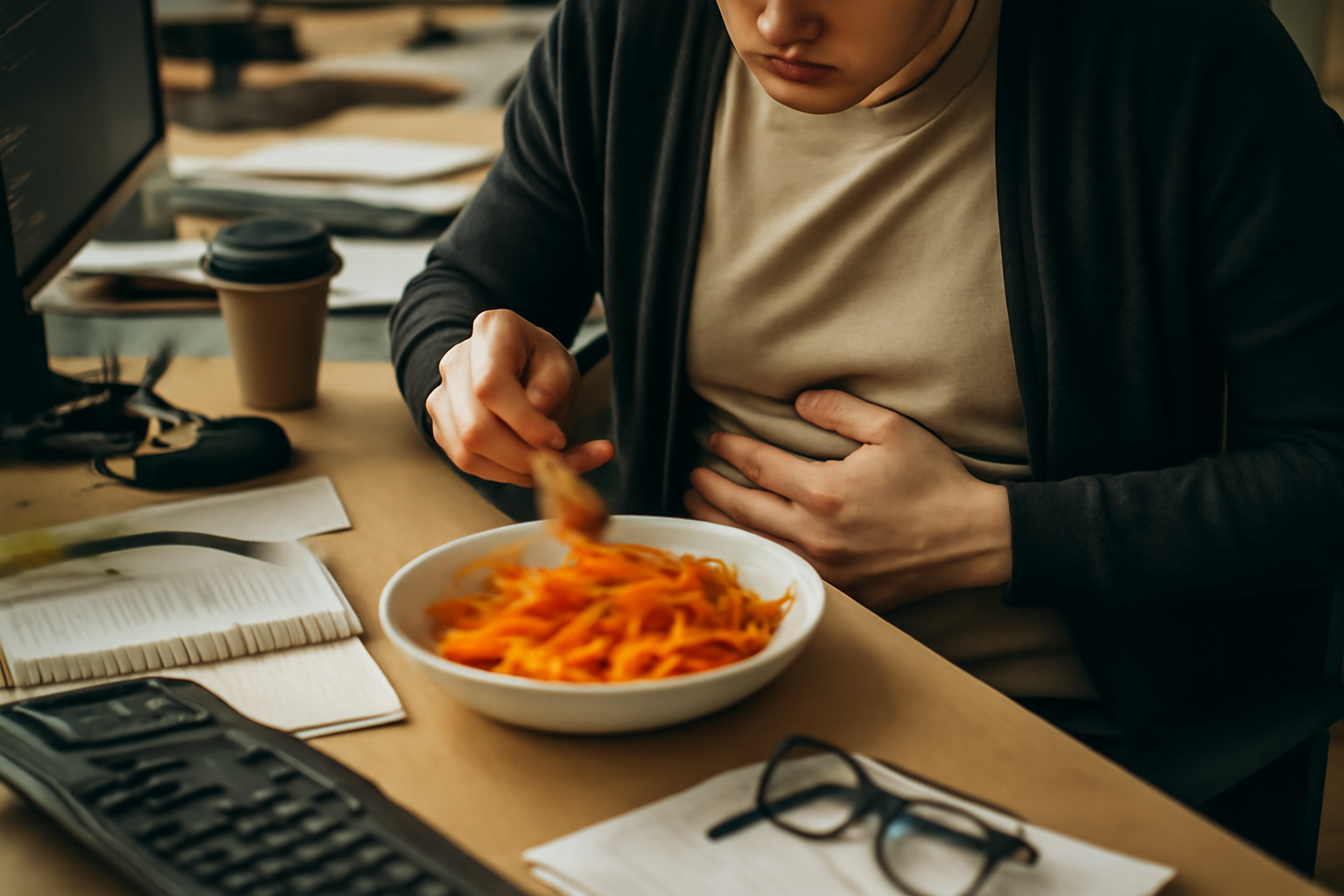

Rapid consumption during meals ranks among the most predictable triggers for post-meal bloating, yet the mechanisms behind it operate in ways many people never consider.
When your typical eating pattern involves speed — whether that’s consuming lunch at your desk, standing over the counter, squeezing meals between back-to-back commitments, or browsing while you eat — the bloating that follows may suddenly make more sense once you understand what’s actually happening inside your digestive tract.
Mechanism 1: Aerophagia and Swallowed Gas Volume
The fastest way to introduce excess air into your digestive system is to consume food or beverages at speed. This phenomenon, known as aerophagia, represents a direct pathway from hurried eating to abdominal distension.
Ingested air travels downward through the stomach and into the upper portions of the small intestine. Belching releases some of this trapped air back out, but a substantial volume persists and progresses further through your intestines, creating pressure and discomfort within the abdominal walls. Carbonated beverages, hurried meals, speaking with food in your mouth, and allowing air in while chewing all intensify this dynamic.
Clinical research examining patients experiencing functional bloating and irritable bowel patterns regularly documents aerophagia as a measurable contributor — and deliberately extending eating duration produces demonstrable reductions in the quantity of gas present in the digestive tract.
Mechanism 2: Insufficient Mastication and Enzyme Substrate
The breakdown of food initiates not in the stomach but rather at the moment teeth first contact the food. Saliva delivers amylase (initiating carbohydrate breakdown) and lingual lipase (beginning lipid digestion). The mechanical action of chewing additionally fragments food into progressively smaller units, exponentially enlarging the total surface area accessible to enzymatic processes further along the GI tract.
Rapid consumption results in swallowing incompletely masticated, oversized food fragments. These fragments:
- Overwhelm the enzymatic capacity present in the small intestine
- Reach your colon in a partially digested condition
- Feed the bacterial colonies residing there, which metabolize them and release hydrogen, carbon dioxide, and occasionally methane as byproducts
This bacterial fermentation constitutes the predominant driver of the bloating and flatulence sensations arising 30–90 minutes following a hastily consumed meal. Proportionally larger food particles correlate with proportionally greater fermentation activity. Greater fermentation activity corresponds to heightened gas generation.
Mechanism 3: Insufficient Enzyme Upregulation
Enzyme secretion and acid production in the stomach and small intestine intensify in response to the physical stimulus generated by mastication combined with the anticipatory signaling triggered before swallowing (termed the “cephalic phase” of digestive activation). Should food travel down too quickly and in excessive quantity, the necessary enzymatic cascade hasn’t yet achieved the magnitude required for optimal processing.
Protein that remains unbroken down by digestive processes generates substantial bloating as colonic bacteria ferment it — and this fermentation yields gas with a notably pungent odour. Consequently, consuming meals rapidly can simultaneously generate both volume distension (from gaseous expansion) and olfactory offensiveness.
Mechanism 4: Satiety Signal Delay and Gastric Overfilling
The hormones responsible for communicating fullness to your brain — leptin, GLP-1, and peptide YY chief among them — require approximately 15–20 minutes from the moment food reaches your stomach before circulating concentrations become sufficient to trigger satiety perception in the central nervous system. Eating at high speed means you routinely consume far beyond the volume that would feel appropriately satisfying before your brain actually perceives fullness.
Overconsumption inherently produces bloating: a distended stomach compresses surrounding abdominal structures and simultaneously impedes the rate at which food material exits from the stomach into the intestines. This prolonged gastric residence time amplifies fermentation processes and intensifies gas production.
Mechanism 5: Sympathetic Activation and Parasympathetic Suppression
The vast majority of rushed eating emerges from a physiological stress state — racing through multiple responsibilities, consuming food with underlying tension, eating mindlessly. Stress engagement switches on the sympathetic nervous system (the physiological “fight-or-flight” mode), which simultaneously deactivates digestive function: acid secretion diminishes, intestinal movement decelerates, and metabolic resources redirect away from gastrointestinal processes.
The vagus nerve orchestrates the “rest and digest” parasympathetic state, which must be in operation for digestion to proceed optimally. Deliberate, unhurried meals — even a simple pause before commencing eating — engages this vagal system and readies the digestive apparatus for efficient functioning.
Practical Interventions With Evidence Support
The research-supported approaches to this issue remain basic in conception, although they do demand behavioral adjustment:
- Increase chewing frequency — target 20 mastications per bite when consuming foods with complex or dense structure. This seems extreme in theory until experimentation reveals the magnitude of change it produces
- Position your utensil down after each bite — this straightforward physical interruption naturally extends the duration of consumption with no reliance on discipline alone
- Eliminate digital distraction during eating — eating while distracted accelerates consumption speed. Your meal velocity tracks in near-perfect correspondence with the degree of technological engagement
- Consume meals in a seated position — standing consumption or eating while mobile increases air intake and transmits a digestive signal reading as “this is not a formal meal”
- Breathe deliberately before starting — a 30-second respite of intentional breathing before the first bite shifts physiology into parasympathetic digestive readiness
- Minimize conversation during chewing phases — speech while masticating produces direct air swallowing
Supplemental Enzyme Support for Rapid Eaters
When circumstances compel you to eat rapidly — circumstantial rather than preferential — a digestive enzyme formula can mitigate some of the consequences stemming from inadequate mechanical processing. This addresses the fermentation and gas originating from insufficiently masticated material traversing your stomach and small intestine, although it cannot resolve the aerophagia component already introduced.
Where enzymes demonstrate benefit
- Protease and amylase facilitate the breakdown of proteins and starches that rapid eating fails to process sufficiently, diminishing the fermentable material that reaches bacterial populations downstream.
- People I hear from typically observe tangible reductions in post-meal distension and fullness sensations when implementing consistent use during meals — generally noticeable within a 3–5 day window of regular administration.
- Multi-enzyme preparations spanning diverse substrate types eliminate uncertainty regarding whether your specific bloating arises from starch, polypeptides, or triglyceride malabsorption.
Where enzyme supplementation has limitations
- Enzyme products cannot compensate for air already swallowed during rapid eating — the aerophagia component proceeds independently of enzyme activity and remains unaffected.
- Those with pancreatic function disorders or receiving specific pharmaceutical agents (anticoagulation therapy in particular) warrant medical consultation prior to enzyme supplementation — significant interaction potential exists.
Think of this as harm reduction, not a fix: if you genuinely can’t change your eating pace in the short term, an enzyme buys you time while you work on slower, more mindful eating. That said, this isn’t solving the root problem.




About This Article

Written by Alex Mercer. Alex Mercer has lived with IBS since childhood and isn't a nutritionist or a doctor. After years of being told he was anxious or would grow out of it, he spent more than 12 years reading the research properly, and now shares what he has learned with the family, friends and support-group members who come to him with the same questions. He translates peer-reviewed research into practical, honest advice, and is always upfront about what the evidence does and does not show. More about this site.
Scope and limits. Alex is not a doctor, dietitian, or nutritionist, and nothing here is medical advice. Talk to a clinician before changing your diet, starting a supplement, or acting on symptoms — especially persistent or worsening ones.
Verify this against a primary source
Specifics change, and your situation may differ from the one described here. These are the authorities worth checking directly:
- NIDDK — digestive disease research and clinical guidance
- MedlinePlus — plain-language medical reference from the NIH
- Mayo Clinic — symptom and condition reference