The short answer: approximately 15–17 grams per day — which is roughly half of what most health guidelines recommend, and dramatically less than what the human gut evolved to handle.
This isn’t a minor nutritional shortfall. The fibre gap between what Americans currently eat and what their gut microbiome needs to function well is one of the most significant — and most underappreciated — contributors to the epidemic of digestive problems, IBS, and metabolic disease in the United States.
The Numbers: What the Research Says
Multiple large-scale dietary surveys — including the National Health and Nutrition Examination Survey (NHANES) — consistently find that American adults consume between 15 and 17 grams of dietary fibre per day on average.
| Group | Average Daily Fibre Intake | Recommended Daily Intake |
|---|---|---|
| Adult women (US) | ~13–15g | 25g (Institute of Medicine) |
| Adult men (US) | ~17–19g | 38g (Institute of Medicine) |
| US average (all adults) | ~15–17g | 25–38g depending on sex and age |
| Hunter-gatherer populations (estimated) | ~50–100g+ | — |
To put the hunter-gatherer figure in perspective: research on populations like the Hadza of Tanzania — whose gut microbiomes are among the most diverse studied — shows fibre intakes often exceeding 100 grams per day from tubers, berries, and plant material. The modern Western gut is operating on a fraction of its evolutionary input.
Why Fibre Matters for the Gut
Dietary fibre isn’t a single nutrient — it’s a diverse family of indigestible carbohydrates that serve different functions in the gut:
Soluble Fibre: The Prebiotic Engine
Soluble fibre (found in oats, legumes, fruit, psyllium, chicory root, garlic, and onions) dissolves in water to form a gel and is fermented by gut bacteria in the colon. This fermentation produces short-chain fatty acids (SCFAs) — primarily butyrate, acetate, and propionate — which are the primary energy source for colonocytes (colon lining cells) and have profound effects on gut and systemic health:
- Butyrate maintains the integrity of the gut lining (reduced intestinal permeability)
- Acetate and propionate regulate appetite, glucose metabolism, and inflammation
- SCFAs reduce colonic pH, suppressing the growth of pathogenic bacteria
Insoluble Fibre: The Transit Regulator
Insoluble fibre (found in wheat bran, vegetable skins, brown rice, and most whole grains) doesn’t ferment but adds bulk to stool, speeds transit time, and reduces constipation. It feeds different bacterial populations than soluble fibre — which is why fibre variety matters as much as volume.
What Low Fibre Actually Does to the Gut
A 2018 study published in Cell Host and Microbe found that a low-fibre diet causes gut bacteria to begin digesting the mucus layer lining the colon — the protective biofilm that separates gut contents from the gut wall — within hours. Without prebiotic fibre to eat, bacteria essentially eat your gut lining instead.
Chronic low fibre intake is associated with:
- Reduced microbiome diversity — fewer bacterial species and significantly reduced populations of keystone species like Faecalibacterium prausnitzii, which is consistently low in people with IBS and IBD
- Increased intestinal permeability (“leaky gut”) — from both reduced butyrate production and degradation of the mucus layer
- Constipation and slow transit — the single most direct mechanical effect of low insoluble fibre
- Increased colorectal cancer risk — well-established across multiple large-scale epidemiological studies
- Worse IBS symptoms — paradoxically, both through dysbiosis and through the loss of gut lining integrity
Fibre and IBS: It’s Complicated
Here’s the nuance that makes fibre advice for IBS more complex than for the general population: some high-fibre foods are also high-FODMAP, and can worsen IBS symptoms in the short term even while being long-term beneficial for the gut.
Garlic, onions, leeks, asparagus, lentils, and chicory root — all rich in prebiotic inulin — are also high-FODMAP foods that can trigger IBS bloating, gas, and cramping. This creates a real tension for people with IBS: the foods that feed the microbiome most effectively are often the ones that feel worst in the short term.
The resolution isn’t to avoid these foods permanently — it’s to introduce them gradually so the microbiome can adapt. Research shows that the gas and bloating produced by inulin-rich foods typically diminishes over 2–4 weeks as microbiome composition shifts in response to the new fibre input.
IBS-Friendly Ways to Increase Fibre
If you have IBS and want to increase fibre without triggering a flare:
- Start with soluble, low-FODMAP fibre first — oats (small portions), psyllium husk, carrots, courgette, and ripe bananas are relatively well-tolerated starting points
- Psyllium husk is specifically well-evidenced for IBS — unlike insoluble wheat bran (which can worsen symptoms), psyllium forms a gentle gel that normalises stool consistency for both IBS-D and IBS-C. Start with 5g per day with a full glass of water
- Add high-FODMAP prebiotic fibres slowly, after a stable baseline — if garlic and onion are confirmed triggers, try the oil infusion technique (cook in oil, then remove) to get prebiotic flavour without the water-soluble FODMAPs
- Increase fibre gradually regardless — jumping from 15g to 35g overnight will cause significant gas and bloating even without IBS. A 2–3g increase per week is a manageable pace
What a Day of 25–30g Fibre Actually Looks Like
Sample day reaching 27g fibre (IBS-friendly starting point)
| Meal | Food | Fibre |
|---|---|---|
| Breakfast | ½ cup rolled oats + 1 ripe banana + 1 tbsp chia seeds | ~8g |
| Morning snack | 1 small orange + 10 almonds | ~4g |
| Lunch | Brown rice (½ cup cooked) + grilled chicken + roasted carrots + courgette | ~6g |
| Afternoon | 5g psyllium husk in water | ~4g |
| Dinner | Salmon + baked potato with skin + steamed green beans + side salad | ~5g |
| Total | ~27g |
This is a meaningful and achievable step up from 15g — without any major dietary overhaul. Psyllium husk is doing a lot of heavy lifting here: it’s one of the most efficient ways to add soluble fibre without adding FODMAP load.
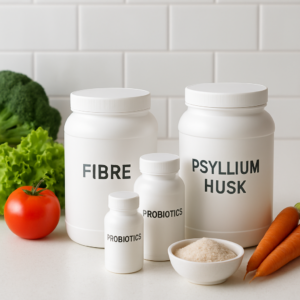
For psyllium husk, NOW Supplements Psyllium Husk Powder is a clean, affordable option. Start with a half teaspoon in a full glass of water and increase slowly over several weeks.
The Bottom Line
The average American eats roughly half the fibre their gut needs to function well. The consequences — constipation, microbiome poverty, impaired gut lining integrity, worse IBS symptoms — are not inevitable. They’re the predictable result of a specific dietary gap that can be closed gradually and intentionally.
For people with IBS, the path requires more care — starting with soluble, low-FODMAP fibres and adding prebiotic-rich foods slowly. But the destination is the same: a gut microbiome with enough raw material to do its job.
The Soluble Fiber Supplement When Whole Foods Aren’t Moving the Needle Fast Enough
If you’re starting from a 15-gram baseline and your gut has been dysregulated for months or years, jumping straight to 30+ grams of whole-food fiber can backfire spectacularly — bloating, gas, and cramping that make you want to quit before you see results. Psyllium husk bridges that gap: it dissolves fully, doesn’t ferment aggressively in an unprepared microbiome, and gives your system a controllable way to climb toward adequate fiber intake without the weekend-ruining side effects.
What works
- Soluble fiber that hydrates and bulks stool gently — clients typically report softer, more regular bowel movements within 3–5 days without the inflammatory spike that insoluble fibers often trigger in sensitive guts.
- Prebiotic effect without aggressive fermentation — psyllium feeds good bacteria, but the mechanism is gentler than resistant starch or inulin, making it a realistic stepping stone for people with active IBS or recent flare-ups.
- NOW’s unflavored powder mixes invisibly into water, tea, or yogurt and contains no added sweeteners, fillers, or gums that can trigger symptoms in chemically sensitive clients.
What doesn’t
- This is not a permanent replacement for whole-food fiber — it’s a training wheels tool to help you tolerate and eventually transition to vegetables, legumes, and whole grains without relapsing into bloating and pain.
- If you have a history of bowel obstruction, strictures (especially in Crohn’s), or are severely dehydrated, psyllium can worsen blockage; talk to your gastroenterologist before starting, and always drink at least 8–10 ounces of water with each dose.
Psyllium works best as a 4–8 week bridge, not a lifetime crutch — the real goal is getting your microbiome resilient enough to handle whole foods again. If you’re not seeing improvement after two weeks, or if bloating is getting worse rather than better, you may have FODMAP sensitivities or dysbiosis that needs a different approach, and that’s a conversation to have with your GP or a gut-focused dietitian. NOW Supplements Psyllium Husk Powder
This post contains affiliate links. As an Amazon Associate, I earn from qualifying purchases at no extra cost to you.